We, as a collective group, do things to get a reaction.
Babies cry to get fed.
Teenagers rebel to get attention.
It's all for a reaction. That in and of itself isn't necessarily a bad thing. No one would do anything if they didn't get something out of it. If audiences stopped laughing, comedians would stop telling jokes. Some of us strive to be "different" and "unique" All they're trying to do is scoff at you when you don't know who Freelance Whales are.
I think a sign of maturity is not doing things for a reaction. I think you've progressed through life and are experienced if you do things for yourself. It sounds easy, but it really isn't. Think about it, when was the last time you did something out of free will, unaffected by society and solely for yourself?
...
It's almost a trait of enlightenment, doing things for yourself.
Monday, January 28, 2013

Tuesday, January 22, 2013
introdyctuion to enlgish
I'm a really bad writer.
I've got Scarlet Letter essay scores to prove it.
I'm a really bad writer.
I've got blog posts to prove it.
I'm a really bad writer.
I've got this blog post to prove it.
When I write I usually have a specific sentence in my mind. I'm given the tail end of a great essay, and I am tasked to rebuild the body and head. I have to work backwards from the first (last) sentence because the last sentence is the first thing I think of about the work. Usually it's a punchline like sentence or group of sentences that goes near the end of the text.
For example, the sentence that was in my mind when I wrote this, and consequently will be the last sentence, was, "See, I told you so." I think the reason I write in this amazingly bad way is due to my personality. I'm quick, sharp and good with one liners. (Testimonials from me, myself and I.) I think I'm funny and interesting, but only for a short amount of time. I usually make a great first impression then ride that. One could go as far as to say that my arrogance, quirkiness and geekiness is just a front for someone who is boring. Because, after all, nobody wants to be boring.
How does this relate to English and writing? Like myself, my writing is prone to rambling and getting sidetracked. This is because I'm not focused and I get distracted because there's one strong "point" (airquotes point airquotes because it's not really a point, it's a sentence) and the rest kind of falls apart. Maybe my writing starts off or finish strong, but usually the body middleish area is lacking and boring.
See, I told you so.
I've got Scarlet Letter essay scores to prove it.
I'm a really bad writer.
I've got blog posts to prove it.
I'm a really bad writer.
I've got this blog post to prove it.
When I write I usually have a specific sentence in my mind. I'm given the tail end of a great essay, and I am tasked to rebuild the body and head. I have to work backwards from the first (last) sentence because the last sentence is the first thing I think of about the work. Usually it's a punchline like sentence or group of sentences that goes near the end of the text.
For example, the sentence that was in my mind when I wrote this, and consequently will be the last sentence, was, "See, I told you so." I think the reason I write in this amazingly bad way is due to my personality. I'm quick, sharp and good with one liners. (Testimonials from me, myself and I.) I think I'm funny and interesting, but only for a short amount of time. I usually make a great first impression then ride that. One could go as far as to say that my arrogance, quirkiness and geekiness is just a front for someone who is boring. Because, after all, nobody wants to be boring.
How does this relate to English and writing? Like myself, my writing is prone to rambling and getting sidetracked. This is because I'm not focused and I get distracted because there's one strong "point" (airquotes point airquotes because it's not really a point, it's a sentence) and the rest kind of falls apart. Maybe my writing starts off or finish strong, but usually the body middleish area is lacking and boring.
See, I told you so.
Sunday, December 30, 2012
less is more
Words complicate things. Liars use more words than necessary. A wordy explanation could leave your listeners confused, a succinct one clarifies. That is why exercises like hamletin6 are so valuable. They forces to to reevaluate what something is and what it means to you. To be able to summarize long novels with multiple themes and ideas in a few words is no easy feat. Although it's not recommended to write essays in a couple of words, it could be useful to review and to think about what a text really means. You have to really think about the story and the underlying morals to be able to summarize a book in six words or less.
In this post, I'll take it to the next level. Here are a few one word summaries of novels we've read before. They are a bit more abstract than six word summaries, but they work just the same.
The Oedipus cycle: Fate
Oedipus tried to run from what was inevitable, and paid the price for it. He couldn't escape his fate, but in the end learned to accept it.
The Jungle: Need
Jurgis and the family always needed something, whether it be coal or food. They always had a need, therefore always needed to do something.
The Scarlet Letter: Pride
Pride kept Hester strong. Pride kept the Scarlet Letter on her blouse and turned it into a symbol of something other.
In this post, I'll take it to the next level. Here are a few one word summaries of novels we've read before. They are a bit more abstract than six word summaries, but they work just the same.
The Oedipus cycle: Fate
Oedipus tried to run from what was inevitable, and paid the price for it. He couldn't escape his fate, but in the end learned to accept it.
The Jungle: Need
Jurgis and the family always needed something, whether it be coal or food. They always had a need, therefore always needed to do something.
The Scarlet Letter: Pride
Pride kept Hester strong. Pride kept the Scarlet Letter on her blouse and turned it into a symbol of something other.
Friday, December 28, 2012
You know what's cool? Bow ties are cool.

Recently, the Doctor Who Christmas special aired. Probably on Christmas day. I won't bore you with the details, but here's quick summary.
- dr sad
- dr visit humans
- human like dr
- human get in trubble
- dr saves the day
- human dies (again)
- Clara Oswin Oswald
Character or story development episodes aren't necessarily bad, just usually. When writers focus on one thing, the episode itself, great things can happen. Shows like The Simpsons and Family Guy don't exactly have an overarching story line. The writers focus on what is happening in the episode and usually that leads to good thing.
This problem only plagues some shows. Doctor Who is a sci-fi action-adventure program and every episode should have action-adventure. If the writers focused on the big picture, smaller episodes wouldn't matter very much. If the writers focused on each individual episode, the show wouldn't be as great as it could possibly be. The creators and writers chose this burden and must live with it, to make the show great.
Thursday, November 29, 2012
anywhere in time and space. every star that that ever was. where do you want to start?
Recently, there was a sale at Barnes and Nobles for "classics" and I snagged myself some H.P. Lovecraft. Howard Phillips Lovecraft was born in 1890, in Rhode Island. He wrote his first story, The Beast in the Cave, at the tender age of 15. He later wrote The Shadow Out of Time in 1833, when he was 28.
For his first story, The Beast in the Cave was rather impressive. Today's teenagers wouldn't have been able to write anything that would come close to rivaling Lovecraft's short story. The scene was set and the mood was well established. An over zealous tourist gets separated from the group and gets lost in a complex cave system. His torch burns out and he has no other choice but to accept his fate. As a last ditch attempt to save himself, the narrator yells and shouts to attract attention. And attract attention he did, of some beast that had been living in the cave.
The Shadow Out of Time is considerably larger and more detailed. It is more or less a 19th century take on Inception. The story is based around an ancient race of creatures who quest for knowledge. Their society is based around the library and knowledge. As time wears on and their bodies fail, they project their minds into other creatures, effectively having a mass exodus of the entire race, hijacking another species' body. This cycle continues on and on until it affects the protagonist of the story. As a way of gaining knowledge, the creatures send probes into the minds of people in other planets and races. They stay in the body for as long as they need and research the civilization.
All-in-all H.P. Lovecraft is a pretty nifty writer. His stories are short, but have a lasting effect.
 |
| "Man! Look at that archway." |
The Shadow Out of Time is considerably larger and more detailed. It is more or less a 19th century take on Inception. The story is based around an ancient race of creatures who quest for knowledge. Their society is based around the library and knowledge. As time wears on and their bodies fail, they project their minds into other creatures, effectively having a mass exodus of the entire race, hijacking another species' body. This cycle continues on and on until it affects the protagonist of the story. As a way of gaining knowledge, the creatures send probes into the minds of people in other planets and races. They stay in the body for as long as they need and research the civilization.
All-in-all H.P. Lovecraft is a pretty nifty writer. His stories are short, but have a lasting effect.
Wednesday, November 28, 2012
Sarcasm^2

There are many other punctuation marks that sound really useful and should be used.
 |
It's a comma combined with a question mark. What else could you ask for? The question comma seems really useful for rhetoric. You could use a series of questions more effectively and it would be more cosmetically pleasing. Isn't underground punctuation the best?
Life is pretty good.
People who complain about life are annoying. I have 4 AP classes, I finish most of my homework on time and I get at least 7 hours of sleep everyday. Life isn't that hard.
As a matter of fact, life is pretty easy. If you want a good grade, work for it. If you don't want to do homework, then don't do it. Just do whatever makes you happy, because let's be honest here being happy is the whole point of anything. If doing something doesn't make you happy now or later on, then it's pointless. Don't waste time trying to do things you don't want to.
Another thing to consider is to not freak out about stuff. Seriously. First off it's bad for you, second off it's incredibly annoying to everyone around you. Especially me. Just go with the flow. Don't stress out about things, just fix them if you can. If you can't, oh well.
 You kids stress out too much. Just take a step back and chill out, bro. Some things are out of your control and you can't change that.
Also, if homework is making you stay up to three in the morning then first of all your working habits are terrible, secondly you'd be better off not doing your homework. Work smart, not hard. If you can't work smart then don't work at all. It's more beneficial to get your sleep and be ready for the next day than to do some flimsy homework assignment that won't help you in the slightest.
As a matter of fact, life is pretty easy. If you want a good grade, work for it. If you don't want to do homework, then don't do it. Just do whatever makes you happy, because let's be honest here being happy is the whole point of anything. If doing something doesn't make you happy now or later on, then it's pointless. Don't waste time trying to do things you don't want to.
Another thing to consider is to not freak out about stuff. Seriously. First off it's bad for you, second off it's incredibly annoying to everyone around you. Especially me. Just go with the flow. Don't stress out about things, just fix them if you can. If you can't, oh well.
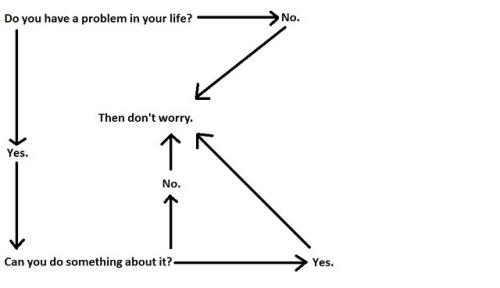
Also, if homework is making you stay up to three in the morning then first of all your working habits are terrible, secondly you'd be better off not doing your homework. Work smart, not hard. If you can't work smart then don't work at all. It's more beneficial to get your sleep and be ready for the next day than to do some flimsy homework assignment that won't help you in the slightest.
Subscribe to:
Posts (Atom)